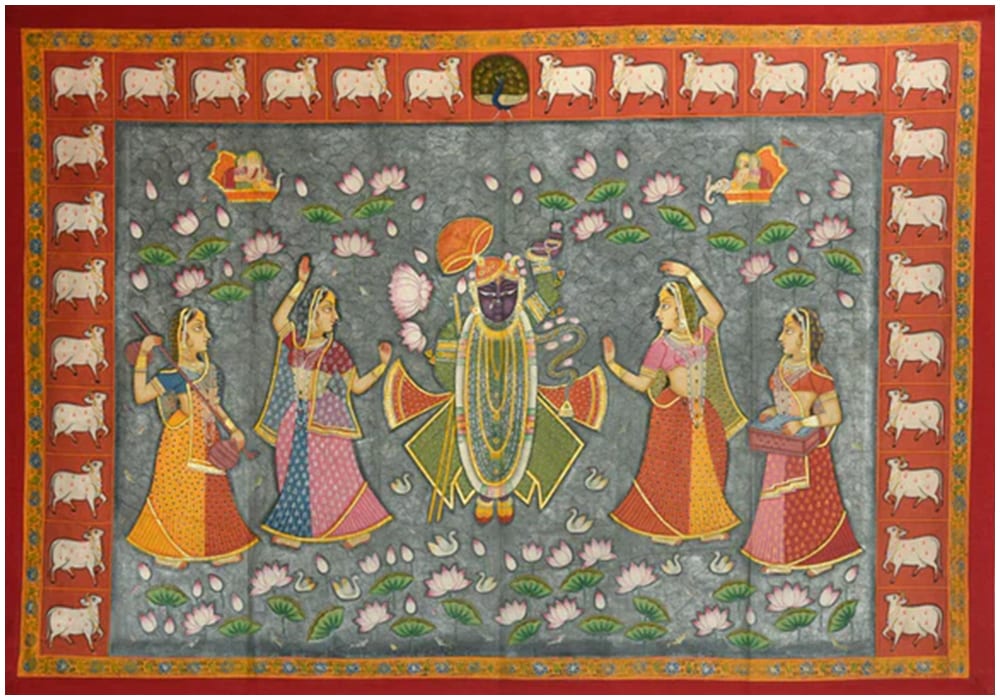
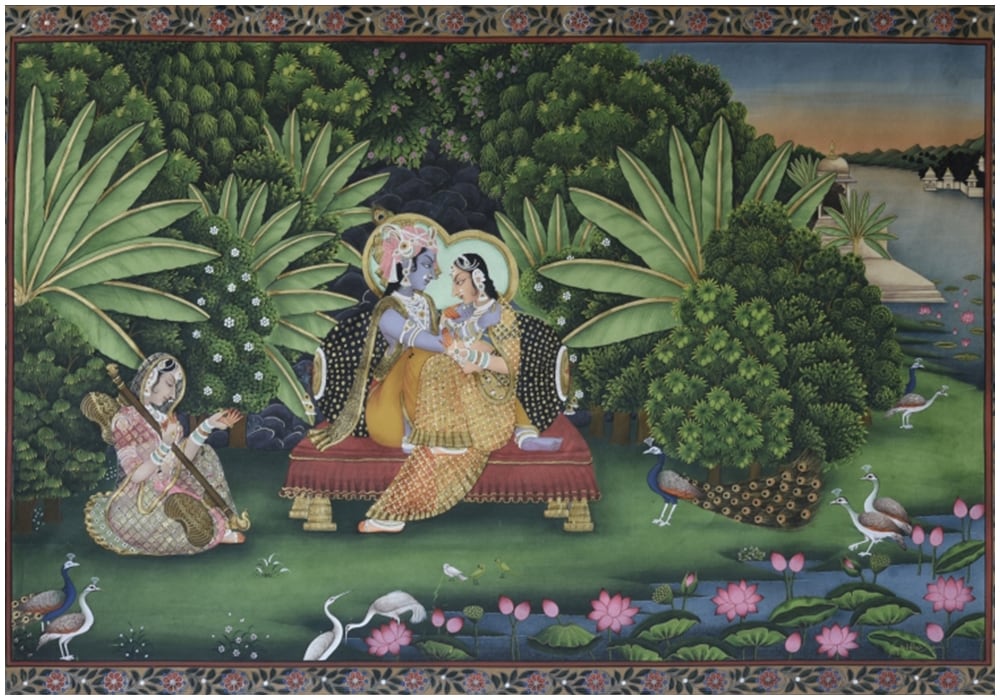
Long before it graced bridal lehengas and runway sarees, Pichwai art served a sacred purpose. Originating nearly 400 years ago in Nathdwara, Rajasthan, these elaborate cloth paintings were created as backdrops for the idol of Shrinathji — a form of Lord Krishna — inside the revered Haveli temple. The word itself tells the story: ‘pichh’ means ‘behind’ and ‘wai’ means ‘hanging’.
Each Pichwai was painted by artists of the Jangad and Gauda castes using natural pigments derived from lapis lazuli, indigo, copper acetate, and mercury sulphide, applied with brushes made of goat and squirrel hair. Themes ranged from Krishna’s Rasleela and the Gopashtami to the iconic Giriraja – Krishna lifting the Govardhan mountain – and the Morbuti, depicting twelve peacocks in a mesmerising dance.

The art was never static. It changed with the seasons, with festivals, with moods of the deity. That rhythm of change is perhaps exactly why it translates so naturally into fashion.
Why Pichwai Is the Trend That Feels Like a Movement
The shift from wall to wardrobe didn’t happen overnight. But in 2025, Pichwai prints are firmly embedded in India’s ethnic fashion vocabulary – not as a passing novelty, but as a statement of meaningful luxury.

Today’s buyer is increasingly drawn to craftsmanship, heritage, and storytelling — things fast fashion simply cannot replicate. Pichwai delivers all three. Each garment often involves hundreds of hours of detailed handwork, with artisans meticulously recreating motifs to maintain the integrity of the original art form. In an age of mass production, this level of investment transforms clothing into something closer to a collectible.
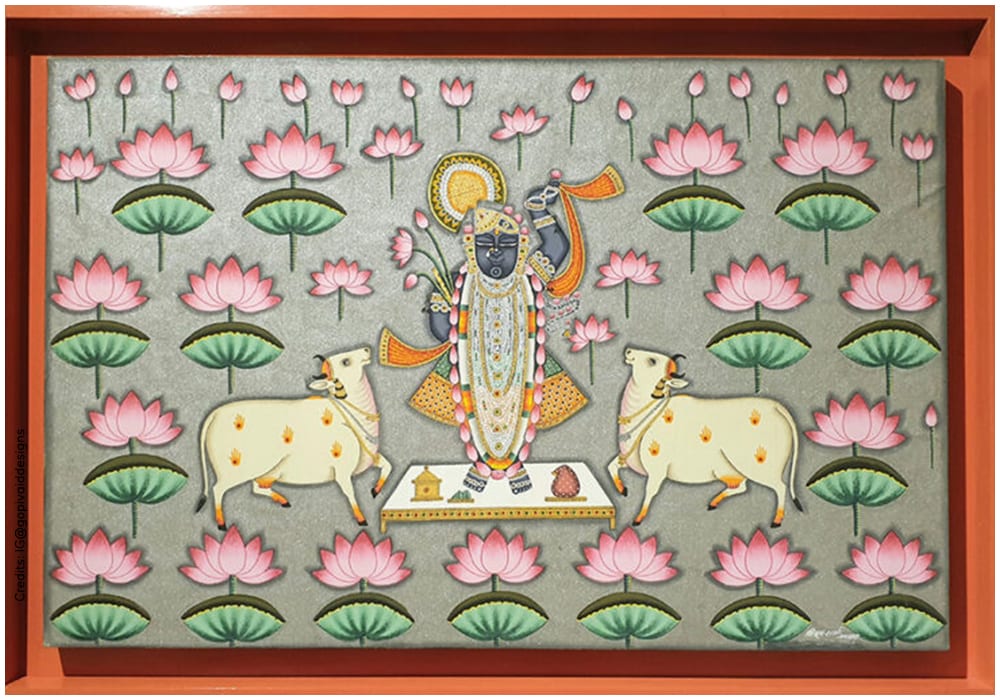
There’s also a cultural pride factor at play. Rather than chasing purely global aesthetics, Indian fashion consumers — especially the younger generation — are reaching for pieces rooted in their own cultural identity. Pichwai gives them exactly that: a garment that carries history as well as style.
Sarees: The Canvas That Started It All
The Pichwai saree is where this fashion revolution first bloomed, and it remains the most accessible entry point into the trend.
Hand-painted Pichwai sarees on tussar, silk, or linen are considered true wearable art. No two are identical — slight imperfections in the brushwork are a mark of authenticity, not error. Artisans paint lotus blooms, cows grazing under moonlight, peacocks in full display, and Krishna scenes across the pallu and body of the saree with extraordinary precision.


For those who prefer something lighter on the pocket, machine-printed and block-printed Pichwai sarees in cotton and georgette offer the aesthetic with greater practicality — perfect for daily wear, brunches, and festive occasions alike. The silk variants, with their rich sheen and elaborate motif work, are reserved for weddings and high-function occasions, paired with temple jewellery and gold blouses for maximum impact.
Styling tip: A Pichwai silk saree with a contrast zari blouse and oxidised silver jewellery is a look that will outlast every fast-fashion trend by decades.
Lehengas: Where Pichwai Meets Bridal Couture
Pichwai lehengas are where the art form truly becomes spectacle. Bridal wear designers have fallen hard for the visual storytelling these motifs offer — a lehenga skirt becomes a canvas for mythological narratives, with deer prancing through forests, lotus clusters blooming at hemlines, and peacocks feathering across dupattas.


The hand-painted Pichwai lehenga is among the most labour-intensive garments in Indian fashion today. A single ensemble can take weeks to complete, as artists transfer traditional Nathdwara motifs — originally scaled for large temple backdrops — onto the curves and folds of a bridal silhouette.
What’s particularly exciting is how designers are updating the format: Pichwai motifs now appear on structured corset blouses, cape-style dupattas, and even pant-lehenga hybrids, bringing the ancient art form firmly into 2025 bridal conversations.
Kurta Sets for Men: Pichwai Steps Into the Modern Gentleman’s Wardrobe
Pichwai is no longer reserved only for bridal lehengas and statement sarees — it has quietly entered menswear, and kurta sets are leading the charge. What makes Pichwai particularly striking in men’s fashion is its ability to balance tradition with understated elegance. Instead of overwhelming the garment, designers often place motifs thoughtfully — along the placket, cuffs, yoke, or as subtle all-over prints that feel refined rather than theatrical.
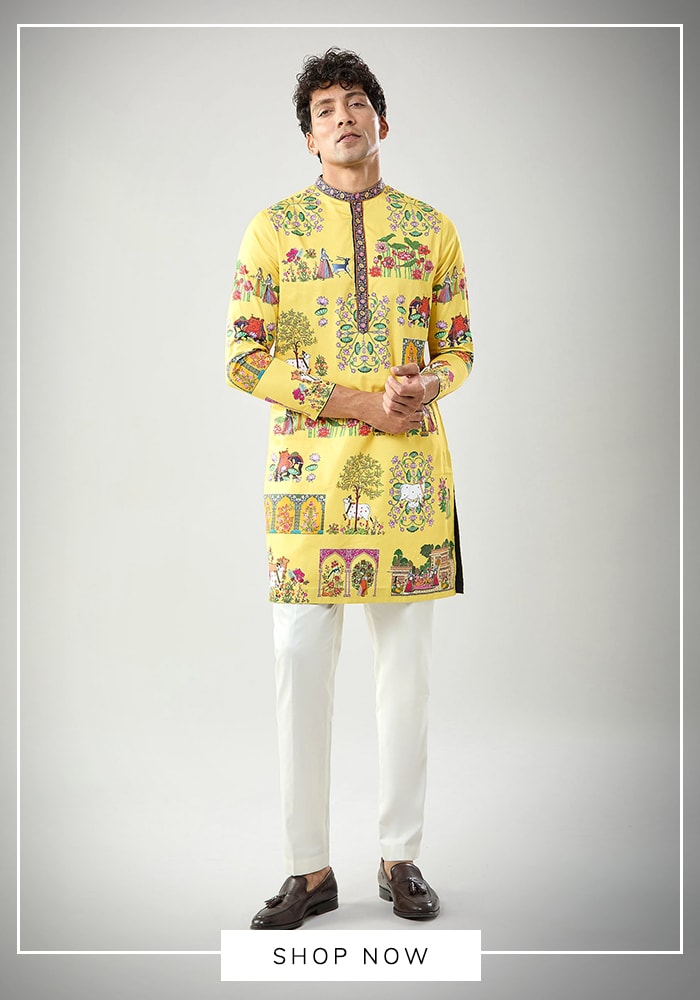
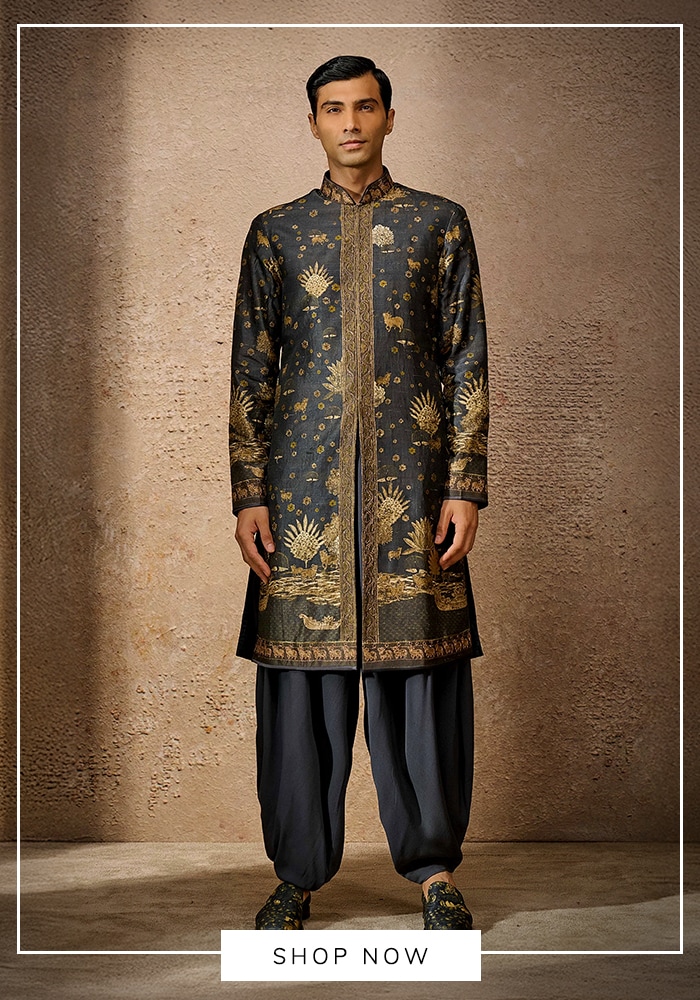
Silk and chanderi Pichwai kurta sets are especially popular for weddings and festive occasions. Motifs like grazing cows, lotus clusters, and delicate peacocks appear in muted palettes — ivory, powder blue, sage green, and antique gold — allowing the artistry to shine without feeling overly ornate. These kurtas are often paired with straight-cut churidars or tailored pants, creating a look that feels rooted in heritage but polished enough for contemporary celebrations.
The Designers Driving the Pichwai Moment
Anita Dongre
No designer has championed Pichwai as consistently and passionately as Anita Dongre. Her journey with the art form began when she encountered master craftsman Lekhraj Ji painting the walls of Jaipur’s City Palace. Moved by his brushwork and concerned about the inconsistency of work available to such artisans, she invited him to her Mumbai design headquarters — and a couture collaboration was born.
Her Pichhwai Collection features limited-edition lehengas, sarees, and gowns in pure silk, each hand-painted in traditional Pichwai style and layered with her signature Gota Patti craft. Her more recent VAANA bridal collection brings together Pichwai paintings and Gota Patti in muted, spring-inspired colour combinations — blush, sage, aqua, mustard — that feel both ancient and utterly modern.
Vineet Rahul
Taking a more experimental approach, Vineet Rahul blends Pichwai prints with contemporary textiles and modern silhouettes, reinterpreting traditional narratives for a fashion-forward audience that wants the story without the formality.
Rajdeep Ranawat
Known for his bold, joyful prints, Rajdeep Ranawat translates Pichwai elements into vibrant, wearable designs with mass appeal. His work has been particularly effective at pulling younger buyers into the Pichwai conversation, making heritage feel genuinely exciting rather than archival.
Celebrities Who Made Pichwai a Red Carpet Conversation
The fastest route from craft studio to cultural mainstream in India runs straight through Bollywood — and Pichwai has found its celebrity champions.

Pooja Hegde made a striking impression at the Akash Ambani–Shloka Mehta wedding in a blue Anita Dongre lehenga hand-painted in the traditional Pichwai style, featuring zari, cutdana, and diamond work. Soft-touch yet richly detailed, the look earned widespread attention for how effortlessly it balanced devotional art with bridal glamour.
Prajakta Koli chose a custom Anita Dongre lehenga with hand-painted Pichwai designs for her wedding day — a deeply personal choice that perfectly exemplified how this art form is finding its way into the most meaningful moments of women’s lives.


Shanaya Kapoor has been spotted embracing modern ethnic silhouettes that incorporate Pichwai-inspired elements, reflecting the growing affinity younger Bollywood stars have for heritage Indian craft.
Anant Ambani was noted for incorporating heritage textiles, including Pichwai-inspired pieces, into formalwear at the grand Ambani wedding celebrations — reinforcing how the art has crossed into menswear territory as well.

Beyond these specific moments, Pichwai’s presence on celebrity Instagram feeds, at couture weeks, and in bridal trousseau conversations has grown substantially. India Couture Week 2025 saw multiple designers referencing Nathdwara-inspired motifs, and the trend shows no signs of plateauing.
How to Wear It: A Quick Style Guide
For festivals (Diwali, Navratri, Janmashtami): A Pichwai silk saree in deep jewel tones — navy, emerald, ruby — paired with a gold zari blouse and temple jewellery. This is the look that was made for festival lighting.
For weddings: A hand-painted Pichwai lehenga in muted pastels with Gota Patti embellishment, styled with polki or kundan sets. Go for a minimal bun to let the garment do the talking.
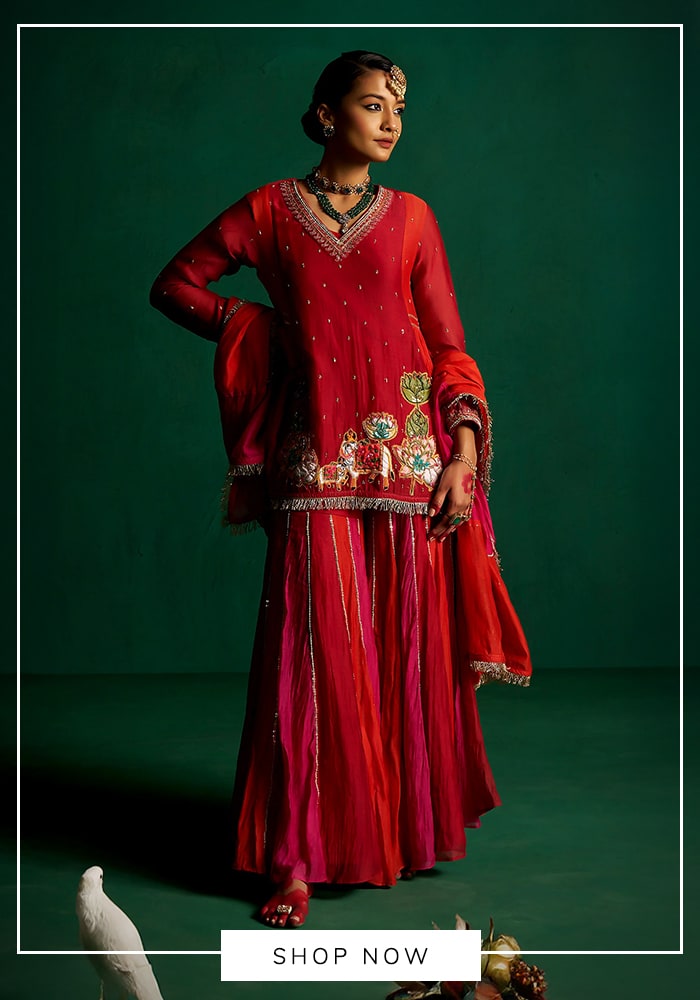

For daytime occasions: A lightweight cotton or linen Pichwai printed saree with a sleeveless blouse, oxidised silver earrings, and a potli bag. Modern, artistic, effortless.
For the adventurous stylist: Pair a Pichwai print skirt with a solid silk crop top, or drape a Pichwai saree with a structured belt at the waist for a contemporary Indo-western twist.
The Bigger Picture: Craft as Luxury, Not Costume
What Pichwai’s fashion moment ultimately signals is a shift in how India defines luxury. For a long time, luxury in Indian fashion meant maximalist embellishment — the more embroidery, the more prestige. Pichwai reframes that equation. Here, luxury is time. It is the hours an artisan spends recreating a lotus with a squirrel-hair brush. It is the decision to use lapis lazuli-derived pigment over synthetic colour. It is the choice to wear something that cannot be replicated on an industrial scale.
That is a powerful story to wear on your body. And as more designers, brides, and celebrities choose to tell it, Pichwai art doesn’t just survive — it thrives, evolves, and finds entirely new walls to grace.
The post From Temple Walls to Couture Runways: The Unstoppable Rise of Pichwai Art in Indian Fashion appeared first on Aza Editorials.